Mangudadatu survives slay attempt in Davao mall

MANILA, Philippines (4th UPDATE) - A failed attempt on the life of Buluan, Maguindanao Vice Mayor Esmael "Toto" Mangudadatu occurred at a Davao City mall Thursday evening.

Initial reports from ABS-CBN Davao said Mangudadatu and 3 of his children went to the JS Gaisano City Mall in Illustre, Davao City to buy toys at around 7 p.m. Thursday.

When the group reached the mall's 4th floor, suspect Tamano Mamalapat allegedly tried to lunge at Mangudadatu while paying for purchases at one of the mall's counters.

"Pagkatapos naming pumili ng mga damit ng mga bata para sa party nila... noong pagbayad niya, lumapit yung lalaking nakaputi sa akin. Akala nung mga andito, mga salesgirls, kasama ko rin," he said.

The suspect then grabbed the gun of one of Mangudadatu's security escorts and aimed at the mayor.

Two of Mangudadatu's security escorts quickly lunged at the suspect, but he escaped and ran towards the housewares section of the mall, where he was shot.

Mangudadatu said Mamalapat is one of the suspects in the November 23 massacre in Ampatuan, Maguindanao, where 57 people were killed.

He also said that the suspect is a nephew of Datu Andal Ampatuan Sr

LP, NP hit Comelec warning on endorsements

But Lakas-Kampi official supports it

MANILA, Philippines (1st UPDATE) - The Commission on Elections (Comelec) regulation on celebrity endorsements should differentiate between those who are paid and those who are doing it for free, according to a member of the communications team of Liberal Party (LP) presidential candidate Senator Benigno “Noynoy” Aquino III.

“It should be clear that the spirit of the law is referring to paid endorsers, not volunteer supporters. It is the right of every citizen, whether an actor or not, to volunteer and support his candidate,” Campaigns and Grey President Yolanda Ong told abs-cbnNEWS.com/Newsbreak when asked to comment on the Comelec reminder. Campaigns and Grey is a marketing-advertising company.

In the 2001 senatorial elections, Ong was involved in the advertising campaign of then senatorial candidate Manuel Villar, Aquino's closest rival in this year's presidential elections. In 2007, she helped Aquino in his successful senatorial campaign.

Aquino, brother of celebrity host Kris Aquino, is said to have the most number of celebrity endorsers among the presidential candidates.

Aside from Kris, Gretchen Barretto, Vilma Santos, and Sharon Cuneta--who all have relatives in the Liberal Party ticket--Aquino is also endorsed by Boy Abunda, Ai-Ai Delas Alas, Dingdong Dantes, Marian Rivera, Ogie Alcasid, Regine Velasquez, Anne Curtis, Erik Santos, Bea Alonzo, Mariel Rodriguez, Sitti, Pooh, Kim Chiu, Kris Bernal, and Aljur Abrenica.

Aquino's spokesman Edwin Lacierda claimed none of them was paid a single centavo for their endorsement.

“It’s a strong and firm belief from among the celebrities that 'Noy is the best leader to govern the country and rid the government of corruption,” Lacierda said.

Mixed reactions

According to Comelec legal department head Ferdinand Rafanan, Republic Act 9006 or the Fair Elections Act is clear that celebrities should go on leave if they are endorsing candidates. Celebrities whose endorsements will be aired during the regulated period will be considered campaigners or campaign volunteers of candidates, he said.

"Kahit sinong media personality, on-air correspondent, basta naging campaigner, volunteer or campaign staff ng kandidato, ang sabi ng RA 9006 (Fair Elections Act), you should resign or take a leave of absence from being media personality," Comelec legal division chief Ferdinand Rafanan told ABS-CBN's Umagang Kay Ganda (UKG). (See story: Comelec: Celebrity endorsers must go on leave)

Section 6 (6.6) of the Fair Elections Act or Republic Act 9006 states: “Any mass media columnist, commentator, announcer, reporter, on-air correspondent or personality who is a candidate for any elective public office or is a campaign volunteer for or employed by any candidate or political party shall be deemed resigned, if so required by their employer, or shall take a leave of absence from his/her own work as such during the campaign period.”

Rafanan said Comelec can file criminal complaints against celebrities who don't go on leave from their shows and programs during the campaign period.

The Comelec warning reminding candidates and celebrities about the provision in the Fair Elections Act generated opposing views from campaign strategists and political advertisers.

NP: It’s unconstitutional

The Nacionalista Party (NP) is questioning the Comelec resolution. NP senatorial candidate Adel Tamano, a constitutional law professor, said the policy violates the Constitution.

“The Comelec resolution implementing section 6 of the Fair Elections Act mandating that celebrity endorsers go on leave is unconstitutional and violates the rights of freedom of association and expression,” Tamano argued.

NP standard-bearer Villar also has a string of celebrities endorsing him. Although fewer in number than Aquino's, Villar's endorsers are very popular among the lower-income sectors of Philippine society--“Comedy King” Dolphy Quizon, Wowowee show host Willie Revillame, multi-awarded singer-actress Sarah Geronimo, and boxing champion Manny Pacquiao.

“Why should celebrities be penalized for expressing their support for candidates? They are covered by the same rights to express their opinions and support candidates that they like, which is a right of all Filipino citizens, so why single them out?” he added.

Tamano is also endorsed by celebrities Robin Padilla and Ogie Alcasid.

“Ogie Alcasid has done a TV commercial for me and is endorsing me. Without his help, it will be difficult for the public to recognize me. Celebrity endorsers serve an important purpose especially for lesser known candidates like myself by acting as the bridge to introduce a worthy but less-known candidate. They level the playing field against candidates who are re-electionists and artista or media personalities who are already well known to the public,” Tamano explained.

“I hate to say it but perhaps this latest COMELEC resolution is a mere ploy to distract the public. The COMELEC has bigger problems to solve – from all these delays in ballot printing and deliveries of PCOS [Precinct Count Optical Scan] machines, to assuring the public that signals won’t be jammed during transmission of election results. Why don’t they concentrate on those first?,” he added.

Comelec supporters

The Comelec's warning, however, was backed by the biggest ad spender in the 2007 senatorial race, former Surigao Del Sur Rep. Prospero Pichay, and campaign strategist Marilou Tiquia.

“That will level the playing filed as far as TV is concerned. If you’re endorsing a candidate, and you appear on the TV shows, you will be identified with the candidate [you are endorsing]. It will be unfair to the other candidates,” Pichay said.

Lakas-Kampi-CMD presidential bet Gilbert Teodoro, who is way behind in the presidential surveys, has few celebrity endorsers.

Pichay, who is now the campaign manager of the administration’s senatorial candidates, did not tap celebrities for his ads in 2007. Pichay failed to win a seat in the Senate despite spending heavily on political ads.

Campaign strategist Marilou Tiquia is in favor of the ruling, too. She was part of the successful "Mr. Palengke" senatorial campaign of Manuel Roxas 'Mar' II in 2004. She also worked for the team that prepared the botched 2010 presidential bid of Senator Francis Escudero.

“I am for it to level the playing field. It’s in the Fair Elections Act. Portion-buys in game shows should not be allowed because only moneyed candidates can do that. Endorsers should be responsible and they should know their limits because political discourse is not about artistas,” Tiquia said.

Villar's camp has been engaged in portion-buys in popular noontime shows, Eat Bulaga and Wowowee. They give out cash and other prizes in these segments.

“Media practitioners should report news and not propaganda. They serve public interests. Opinion-makers, on the other hand, should adhere to fair play and call a spade a spade, and no embellishment should be made so that readers are able to filter spin from the truth,” she added.

Confusing ruling

LP campaign manager Butch Abad said the Comelec regulation is "confusing" and "highly irregular."

"The Supreme Court reversed a 100-year-old policy that requires appointive officials to resign when they file their certificate of candidacy. They are able to use and employ the influence of their office to have undue advantage in the election. And now, these entertainers, these volunteers, you are making them suffer by forcing them to forgo their livelihood? They are only exercising their right to free speech," Abad told abs-cbnNEWS.com/Newsbreak.

Abad was referring to the SC ruling that allows appointed officials, including police generals, to keep their posts even if they are running for public office. This has allowed President Arroyo and some Cabinet members, who are seeking national and local elective posts, to continue serving the administration, thus giving them an undue advantage over their rivals.

"It's highly discriminatory and therefore unconstitutional Bakit kapag kakampi nila, they whimsically change a long-standing policy just for political accommodation. They make these people, these entertainers, suffer. It shows that the government is biased and does not follow the rule of law," Abad added.

China: Large hacker training Web site shut down


Washington -- Police in China shut down what officials think was the largest training Web site for computer hackers, local media said.

The Black Hawk Safety Net offered lessons on cyber attacks and sold Trojan software, which allows outside access to a computer when remotely installed, media reports said.

Police arrested three people who ran the Web site and charged 100 to 200 yuan ($14 to $29) for lessons, the China Daily newspaper said.

Established in 2005, the site had recruited more than 12,000 paid and 170,000 free members and collected more than 7 million yuan ($1.02 million) in membership fees, the reports said.

Authorities were tipped off to its existence while investigating a cyber attack in 2007. Some suspects arrested in that case were members of Black Hawk.

The suspects in the Black Hawk case were arrested under a law revised last year in response to cyber crimes.

China says hackers caused 7.6 billion yuan ($1.02 billion) in losses in the country last year.

Last month, online search giant Google threatened to pull out of China, saying Chinese hackers had penetrated some of its services in a politically motivated attempt at intelligence gathering.

China's information information technology ministry called the accusations of government involvement "groundless."

The Chinese government has said that the Google case is a business dispute and should not affect relations between Beijing and Washington.

Last month, foreign correspondents in at least two Chinese bureaus of news organizations had their Google e-mail accounts attacked, with e-mails forwarded to a mysterious address, according to the Foreign Correspondents' Club of China.

World War II-era navigation system shut down

Washington -- Good night, Loran.

In a series of small ceremonies, the U.S. Coast Guard on Monday shut down Loran-C, a navigation and timing system that has guided mariners and aviators since World War II.

The death blow came last May when President Obama called the system obsolete, saying it is no longer needed in an age in which Global Positioning System devices are nearly ubiquitous in cars, planes and boats.

Killing Loran-C will save the government $190 million over five years, Obama said. But supporters of Loran -- including the man known as "the father of GPS" -- say the nation's increasing reliance on GPS paradoxically has increased the importance of maintaining Loran as a backup.

Supporters also argue that the mere existence of Loran makes the GPS satellite system a less attractive target for cyber-thugs, terrorists or future military adversaries.

GPS systems today are used not only for navigation, but also to provide precise timing for ATM machines, cell phone towers, water plants and other enterprises, and positioning information for precision-guided weapons for the military. GPS disruptions can be costly to business, dangerous for travelers, and debilitating to the military.

Supporters of Loran -- short for long range navigation system -- say the system is a near-perfect backup because it provides similar information to GPS, but has dissimilar infrastructure.


GPS is based on a constellation of at least 25 satellites; Loran is based on 24 ground stations in the United States, and others elsewhere. GPS transmits a very faint signal and is vulnerable to interference or jamming; Loran has a high-power signal which can penetrate obstacles like foliage and is harder to interrupt. GPS is powered by solar panels; Loran is tied to ground power. And while GPS operates in outer space, outside of controlled perimeters, Loran operates inside controlled perimeters in the United States.

The vulnerability of GPS and the consequences of an outage became evident in 2007 during a Navy training exercise in the Port of San Diego, California. Participants unintentionally jammed GPS signals in the region, shutting down satellite navigation and cell phone service up to 10 miles inland for three hours.

The satellite-based system's vulnerability became apparent a second time that year, when China tested an anti-satellite weapon, destroying one of its own aging weather satellites.

Indeed, in recent years, as the popularity of GPS soared and the number of Loran users dwindled, the fate of the Loran system has followed a meandering path of near-death and rebirth experiences that even the most sophisticated navigation system would have difficulty tracking.

During the Bush administration, the system was at one point placed on the chopping block, but was resurrected amid a flurry of reports from Loran backers.

In late 2006, an Independent Assessment Team headed by Bradford Parkinson, known as the "father of GPS," unanimously recommended that an enhanced version of Loran, known as eLORAN, "be completed and retained as the national backup system for GPS," saying it had "critical safety of life, national and economic security, and quality of life applications."

The assessment team recommended that the government complete the eLORAN upgrade and commit to eLORAN as the national backup to GPS for 20 years.

But the Obama administration has described Loran as unnecessary and antiquated. In a May 7 speech, Obama used Loran as an example of government waste.

"This system once made a lot of sense, before there were satellites to help us navigate," Obama said. "Now there's GPS. And yet, year after year, this obsolete technology has continued to be funded even though it serves no government function and very few people are left who still actually use it."

So at 3 p.m. Monday, the U.S. Coast Guard turned off Loran signals at 19 of the 24 Loran stations. Signals remain at five stations because of agreements with Russia and Canada, but the Coast Guard expects those stations to be decommissioned by June after the United States receives verification that those countries have been notified of the change.

The five stations that temporarily remain on line are at Attu, in Alaska's Aleutian Islands, and Caribou, Maine; Nantucket, Massachusetts; Shoal Cove, Alaska; and George, Washington.

Chief Warrant Officer 4 Dave Robbio said the Loran signals at the 19 closed stations will be on a "hot stand-by" for the next week, allowing the signals to be turned back on if something unforeseen occurs. If there are no problems, the transmitters will be completely powered down next Monday.

Some congressional critics say it is a mistake to shut down the system. In a November letter to Homeland Security Secretary Janet Napolitano, two top members of the Senate Homeland Security Committee urged that Loran-C be spared. Deploying an enhanced Loran, or eLORAN, would cost about $100 million, Sens. Joseph Lieberman, I-Connecticut, and Susan Collins, R-Maine, wrote -- about one half the amount of placing one new GPS satellite in orbit, they said.

But the case for dismantling Loran also has its advocates, including the U.S. Coast Guard. In a submission to the Federal Register, the Coast Guard said Loran-C was not established as, nor was it it intended to be, a backup for GPS. Other radio navigation systems, or operational procedures, can be used as backups for GPS navigation and other critical applications, the Coast Guard said.

The Department of Homeland Security says it is currently reviewing the nation's critical infrastructure "to determine if a single, domestic system is needed as a GPS backup."

"The continued active operation of Loran-C is not necessary to advance this evaluation," DHS said.

But hope springs eternal for some Loran supporters, who hope the Coast Guard will mothball the system rather than destroy it.

Mothballing the stations would allow the government to resurrect the system if ongoing studies show Loran is the appropriate backup for GPS. But one Loran supporter acknowledged that hopes of reviving the system, at this point, may just be "wishful thinking."

Toyota recalls more than 400,000 hybrid cars


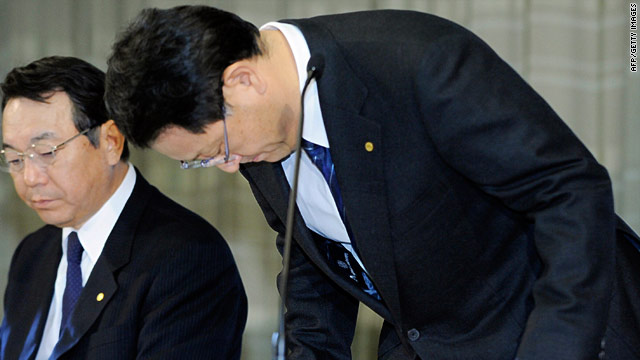
Tokyo, Japan-- Toyota's president apologized profusely Tuesday as he announced the global recall of more than 400,000 of the automaker's 2010 hybrid models, including the popular Prius, for problems in their anti-lock braking systems.

"We do apologize for the inconvenience and concerns we've given to the customers," President Akio Toyoda said in making the recall announcement from the automaker's headquarters in Tokyo. "Quality is our lifeline for Toyota."

The company will work to recover its customers' trust, Toyoda said.

The automaker filed recall papers early Tuesday afternoon with the Ministry of Land, Infrastructure and Transport. Recall papers will be filed in the United States sometime Tuesday.

The recall adds to the woes of the beleaguered automaker, which had previously recalled more than 8 million cars in recent months. This latest recall was the first of Toyota vehicles sold in the domestic Japanese market.

The worldwide recall involves 437,000 vehicles, including the Toyota Prius and Sai, along with the Lexus HS250h. The Sai is sold primarily in Japan.

Sales of the Sai and Lexus HS250h will be halted until a fix is in place.

The Japanese automaker filed recall papers early Tuesday afternoon with the Ministry of Land, Infrastructure and Transport.

The announcement was made by Toyota President Akio Toyoda and Shinichi Sasaki, vice president of quality control, at the Toyota offices in Tokyo. U.S. officials will be notified of the recall on Tuesday morning.

Video: Prius to be recalled

This was Toyoda's second press conference apologizing for Toyota problems since Friday. Toyoda had widely been criticized for remain silent as recall problems mounted in North America, Europe and China.

Last week, the company admitted a problem with the software that controls the anti-lock braking system of the 2010 model of the car and said it had found a solution for cars that started to roll off of the assembly line in Japan last month.

It has yet to find a solution for the estimated 37,000 cars already on U.S. roads or the more than 200,000 of the 2010 model year vehicles that have been sold worldwide, but the company said Friday that a solution was "near."

Jim Lentz, president of Toyota Motor Sales in the United States, during an online video interview Monday evening, declined to say when -- or if -- Toyota would recall the car.

"We're going to do whatever it takes to make sure our customers feel secure and safe with our products," Lentz said of the Prius issue.

When the problem was originally brought to light last week, Toyota executives initially described it as a momentary delay in braking when the car was driving over slippery or bumpy surfaced such as ice or rutted roads.

Lentz, speaking about the problem on Digg.com Monday, described it as a change in braking feel, a description that Toyota has begun using more recently when talking about the issue.

The U.S. National Highway Traffic Safety Administration announced last week that it was opening a formal investigation into braking problems with the 2010 Prius. Nearly 125 Prius owners had lodged complaints about the problem. A spokeswoman for the highway safety agency said Monday that Toyota had not confirmed any recall plans.

Separately, the total number of vehicles Toyota Motor Corp. has had to recall for gas-pedal related issues now comes to 8.1 million.

We do apologize for the inconvenience and concerns we've given to the customers
--Akio Toyoda, Toyota president

The 8.1 million figure includes a total of 5.8 million vehicles recalled, around the world, for an issue in which accelerator pedals could become stuck in floor mats.

Of those, 5.3 million are being recalled in the United States. A total of 4.5 million vehicles, worldwide, are being recalled for a problem in which gas pedals, as they wear, can become sticky and not come all the way back up when the driver takes his foot off the pedal. Of those, 2.3 million are under recall in the U.S.

Toyota officials estimate the total cost of the global recall could be as much as $2 billion, including the loss of 100,000 vehicle sales in the United States and Europe.

Last week Toyota has posted a $1.7 billion profit for the quarter ending December 31. The company also upgraded its forecast and is projecting to end the fiscal year in March to an $880 million profit. The company previously forecast a $2.2 billion loss this year.

In the wake of the recalls, Toyota's share value has dropped about 20 percent.

Smartmatic vows to solve transmission failures

Buys 5,000 satellite antennas

MANILA, Philippines – Smartmatic has acquired satellite antennas for areas in the Philippines that have no stable telecommunication capacity, a company official said.

“We already acquired 5,000 satellite antennas,” said Smartmatic International Sales Director Cesar Flores during ABS-CBN News Channel's (ANC's) E-Leksyon Forum held Friday at ABS-CBN's Dolphy Theater.

Smartmatic is the Venezuelan company that won the bid for the country's first nationwide automated elections. It is supplying Precinct Count Optical Scan (PCOS) machines that will automatically count the votes cast.

Lack of a telecommunications signal or GSM signal, would hinder the electronic transmission of results from the precincts to the municipal, provincial, and national canvassing.

“What happened to Taguig and Pateros is just that,” Flores said, referring to the field tests done Friday, which had problems transmitting the results.

(Know more about the results of the field testing of the machines: What went wrong, right on 2nd poll automation field test)

Flores said that these field tests are being done to anticipate problems that must be addressed. He also said transmission problems had been expected.

“There will be issues. It is naïve to think that nothing will happen. The important thing is that we must know what to do,” he said.

To address the transmission glitches, Smartmatic opted to acquire satellite antennas.

“If you cannot resort to GSM transmission, then you need satellite transmission, or resort to a contingency transmission,” Flores said.

He did not, however, elaborate on the contingency transmission.

Antenna sharing of clustered precincts


ased on Smartmatic’s site surveys of network availabilities in the various precincts nationwide, only 65% of the total number of polling centers have stable telecommunication capacity.

There will be 76,000 clustered precincts or polling centers in the country for the May 10 polls.

The remaining 35%, or around 24,000 clustered precincts, will need satellite antennas for secure electronic transmission of the results.

Flores said they are still looking into which precincts need the satellite antennas, and how the precincts can share the antennas.

Because of the results of their site surveys, Flores said that they were not expecting that 90-95% of the transmission, during the 2 field tests, would go smoothly.

The areas where the tests failed would have to resort to electronic transmission using satellite antennas.

Will extreme conditions destroy machines?

Commission on Elections (Comelec) Commissioner Gregorio Larrazabal said mock elections will be done on February 6 to test whether the machines can withstand extreme conditions.

He said the testing and sealing of the machines will also be done 3 to 7 days before the elections in the designated polling center of the machine.

Flores said the machines they have manufactured have undergone “very strict testing.”

He said they have conducted elections in other countries that have more extreme weather conditions, such as in the very hot Amazon jungle, and in mountains with very low temperatures.

The PCOS machines that Smartmatic manufactured were left for 24 hours in a place with 95% humidity, Flores added.

Antonio Tinio, chairperson of the Alliance of Concerned Teachers, pointed out that during field tests, there will be no transmission testing.

His worry is that although the machine might work during the tests, transmission will not.

Both Comelec and Smartmatic did not have an answer for this in the forum.

Justice Corona's voting record favors Arroyo

MANILA, Philippines --The voting record of Supreme Court Associate Justice Renato Corona, who has finally broken his silence and accepted the nomination for Chief Justice, shows that he has consistently sided with the administration in politically-significant cases.

When Newsbreak tracked the voting pattern of Supreme Court justices, including the two leading contenders for chief justice—Corona and Justice Antonio Carpio—from 2001 to early 2008, Corona lodged a high 78 percent in favor of Arroyo, with Carpio at 42 percent. (Read: Voting pattern of Supreme Court justices)

Corona is the sole senior magistrate to consider, what many legal experts say, is a midnight appointment to the SC.

He has deviated from his colleagues in the High Court who have said they would vie for the post only under a new administration. His biggest rival for the post, Justice Antonio Carpio, agreed to be nominated if the appointment will be made by the next president. Another magistrate, Justice Conchita Carpio-Morales, held the same view.

Various sectors have argued that President Arroyo should not pick the replacement of Chief Justice Reynato Puno, who retires on May 17, because of the appointment ban.

The 1987 Constitution bars the president from issuing appointments two months before the elections, which, in this case, starts on March 11, and until the end of his or her term.

Clashing positions

This is not the first time though that the two most senior justices, Carpio and Corona, clashed in their stance.

In Quinto v. Comelec, Corona voted with the majority, which struck down as unconstitutional the provisions in the Omnibus Election Code and the Poll Automation Act stating that appointive officials are considered effectively resigned once they file their certificates of candidacy (COC).

These provisions, the 8 concurring justices said, tilt the balance in favor of elected officials who can still remain in their seats despite filing their COCs.

Carpio sided with the 3 other justices in the minority. In his dissenting opinion, he wrote that “An appointive public official who files a certificate of candidacy violates the express constitutional ban on civil service officers from engaging in any partisan political activity except to vote.”

The petition was filed by Arroyo’s election lawyer, Romulo Macalintal. The case involved then Department of Environment and Natural Resources (DENR) Undersecretary Eleazar Quinto and DENR Director Gerino Tolentino, who argued that they should only be mandated to leave their posts at the start of the campaign period.

Philippine Star reported that then Solicitor General Agnes Devanadera filed her comment on the case and urged the SC to resolve the issue.

Devanadera, as it turned out, was one of the Cabinet officials who would benefit from the SC ruling. Currently the justice secretary, she has filed her certificate of candidacy for the congressional seat of the first district of Quezon province.

Aside from Devanadera, other Cabinet officials who gained from the decision were:

  • Executive Sec. Eduardo Ermita, who seeks to represent the first district of Batangas in the House of Representatives;
  • Presidential legal counsel Raul Gonzalez, who’s running for mayor of Iloilo City;
  • Department of Agriculture Secretary Arthur Yap, who’s running for Congress in the 3rd district of Bohol;
  • Budget Sec. Rolando Andaya, who aims to reclaim his post as representative of Camarines Sur.

Kokoy Romualdez

Corona also voted in favor of another Arroyo ally, Benjamin “Kokoy” Romualdez.

The SC, in a vote of 8-4, reversed itself and ruled that Romualdez cannot be prosecuted for holding two government positions and receiving compensation for these posts because the charges against him had already prescribed. This means that the filing of charges was done beyond the 15-year prescriptive period.

Romualdez’s youngest son, Leyte Rep. Martin Romualdez, is the senior vice-president for finance of the Lakas-Kampi-CMD political party.

Romualdez was able to run unopposed in 2007 after Arroyo asked Leyte Rep. Remedios “Matin” Petilla, who planned to run for re-election in May, to give way. Petilla did, and was later appointed as chairperson of state-owned IBC-13 and vice-president of the Philippine Amusement Gaming Corp (PAGCOR).

Carpio dissented in this case.

Crucial cases

Prior to these cases, Corona and Carpio had contrary opinions on other important policy issues:

  • The SC, in a vote of 8-7, declared the Memorandum of Agreement on Ancestral Domain (MOA-AD) between the government and Moro Islamic Liberation Front unconstitutional. Corona said it was moot and academic because the MOA-AD was not signed; Carpio sided with the majority.
  • The SC, in a vote of 9-4, ruled that the RP-US Visiting Forces Agreement did not violate the Constitution, but said that the transfer of rape convict Lance Cpl. Daniel Smith to the US Embassy was not in accordance with the agreement. Corona was with the majority, Carpio dissented.
  • The Court struck down the People’s Initiative case which sought to revise the Constitution and change the current presidential form of government from presidential to parliamentary. Carpio wrote the decision; Corona dissented.
  • The SC declared the joint venture agreement (JVA) signed by PEA and Amari null and void for violating Section 3, Article XII of the 1987 Constitution which prohibits private corporations from acquiring any kind of alienable land of public domain. The High Court also enjoined the said entities from implementing the JVA. Corona was with the majority initially, but when the SC denied with finality the motions for reconsideration filed by Amari Coastal Bay Development Corporation, he reversed himself and dissented. Carpio wrote the ponencia.
  • The SC upheld executive privilege, which then Socio-economic Planning Secretary Romulo Neri invoked when asked in a Senate inquiry what Arroyo's instructions were to him on the aborted $329-million NBN-ZTE telecommunications deal. Corona sided with the majority; Carpio dissented

It will be worth watching now how the two will vote on the case questioning the constitutionality of President Arroyo's martial law proclamation last December.

Arroyo placed Maguindanao under military rule after armed supporters of the political clan Ampatuans allegedly caused unrest in the area, following the arrest of Datu Unsay Mayor Andal Ampatuan Jr. for the November 23 Maguindanao massacre.

Ties to Arroyo

Interestingly, though, the two were previously closely affiliated with Arroyo before they were appointed to the SC. Their appointment to the Tribunal initially even rang the alarm bells for court watchdogs and observers, who doubted their capacity to be independent jurists.

Carpio was a senior partner of the Carpio Villaraza & Cruz law firm, (more popularly known as The Firm), whose clients included the Arroyos.

During the height of calls for the ouster of then President Joseph Estrada in 2001, The Firm played a key role in ensuring a swift changing of guards, which entailed installing then Vice President Arroyo to the presidency.

Carpio helped draft the letter of Arroyo to then Chief Justice Davide, which stated that she will take over the position as Estrada was already “permanently incapable” of functioning as chief executive.

During that time Corona was also by Arroyo’s side, as her chief of staff and spokesperson. He has also served her as chief presidential legal counsel, acting executive secretary, and presidential chief of staff.

When the two entered the Court, however, their differences emerged.

'Pacquiao to fight Mosley or Mayweather next'


MANILA, Philippines – Pound-for-pound king Manny Pacquiao will fight the winner of the May 1 bout between Americans Floyd Mayweather, Jr. and Shane Mosley, disclosed 4-time Trainer of the Year Freddie Roach.

“I think it will happen, and it will be Manny’s next fight. What has happened may make the fight bigger,” Roach replied to the question of The Telegraph’s Gareth Davies on when the Pacquiao-Mayweather fight will take place.

The blockbuster bout, which was scheduled on March 13, did not push through because the fighters’ camps disagreed on the drug testing procedure.

Pacquiao now has Ghanaian Joshua Clottey as his opponent in a welterweight fight on March 13 at the Cowboys Stadium in Arlington, Texas.

The 2009 Fighter of the Year and Fighter of the Decade, as declared by the Boxing Writers Association of America, will put his World Boxing Organization (WBO) welterweight title on the line.

Meanwhile, Mayweather will face Mosley on May 1 at the MGM Grand Garden Arena in Las Vegas, Nevada, the venue of his cancelled clash with the Filipino boxing sensation.

Mosley and Mayweather have already signed the contract, according to ESPN.com. It has not yet been confirmed if Mosley, the World Boxing Association (WBA) welterweight super champion, will defend his title.

Mayweather over Mosley

“I think Mayweather will fight Shane Mosley, but if he doesn’t, it will make the fight with Manny happen sooner. If Floyd does fight Shane, that’s a good fight, and one I’d like to see,” Roach stated.

He then declared his fight prediction: “But Mosley will be beaten by Floyd. Mosley does well with guys who will come at him. He has had trouble with guys who move. Mayweather wins that fight. But Mosley is a brave guy. If for any reason Mosley wins, Manny would definitely fight him. We’ll take that fight.”

Mosley was one of Team Pacquiao’s choices to be Manny’s next foe after his sensational 2nd round knockout win over Ricky Hatton last May 2.

Pacquiao instead chose to challenge then WBO welterweight champion, Miguel Cotto of Puerto Rico.

He was successful in his November 14 fight when he defeated Cotto via technical knockout in Round 12 to become the only boxer to win 7 titles in 7 different weight divisions.

iPad apps likely to be bigger, pricier

If recent gadget history is a guide, consumers considering Apple's new iPad won't focus so much on the product specs -- the big screen, fast processor, long battery life and the like.

They'll look instead at what the product can do.

And to find out, they'll turn to its lineup of apps -- those cheap, downloadable programs that run on mobile phones and other gadgets.

"The reason why people buy an iPhone is because there are 140,000 apps and you can change your iPhone into anything you want," said Gene Munster, a senior research analyst at Piper Jaffray.

At the iPad's unveiling last week in San Francisco, California, Apple Inc. CEO Steve Jobs went to great lengths to say how robust the iPad's app "ecosystem" will be. He said app developers will encounter a "gold rush" of opportunities if they develop programs for the device.

He showed off a new suite of $9.99 iWork apps for constructing spreadsheets, creating presentations and designing document layouts.

The turtleneck-clad Jobs also trotted out game developers such as Travis Boatman, who said Electronic Arts, where he is a vice president, will redesign its games to be cooler, faster and, above all, bigger on the iPad's 10-inch screen.

"It's a little bit like holding a hi-def television just inches from your face," Boatman said at the presentation, referring to gaming on the new device.

But not everyone is sure the iPad will see the same flood of app-development that followed the releases of the iPhone and iPod Touch, two pocket-size devices known for accessing the world's largest database of mobile applications, Apple's App Store.

And, according to Munster and others, iPad apps are likely to be more expensive -- in the range of $4 for an average iPad app instead of $1.90 for apps on the iPhone, he said.

Apple declined to comment for this report.

iPhone games, widgets and programs already for sale in the App Store will automatically enlarge to fill the iPad's larger screen. Apple's App Store is the leading source of smartphone applications and about nine times larger than Google's rival Android Market, which sells a reported 16,000 apps for Android-based phones.

But app developers and mobile experts said the iPad isn't capable of anything fundamentally different from the iPhone and iPod.

All three of those touch-screen gadgets have accelerometers, which allow users to, among other things, tilt their phones to the left and right to control mobile games. All have GPS compasses, allowing for some neat mapping and navigation apps based on a person's position on the globe.

Essentially, apps on the Apple iPad simply may be bigger versions of what's come before.

That makes the iPad potentially less exciting for developers than the iPhone, said Peter Farago, vice president of marketing at Flurry, a group that tracks app sales, and who formerly worked in the video-game industry.

"The innovation is going to be limited to what's possible [on the iPad], you know," he said. "I don't think imagination can override the true limits of what's offered."

Farago added that no one was sure what programs developers would create for the iPhone when it debuted in 2007. Similar surprises could result once the iPad goes on sale in about two months, he said.

The larger iPad screen may also make new advertising schemes possible, since banner ads don't fit on the iPhone without blocking a substantial portion of its 3.5-inch screen, he said.

Even if apps on the iPad are simply bigger versions of what's available now, that still might make them more interesting.

Michael McWhertor, senior editor of the gaming blog Kotaku, said the iPad's 10-inch screen will give developers room to bump touch-screen controls off of the video game itself. So, where a person might have had to put their thumbs in the way of video-game action on the iPhone, a sliver of touch-screen space used only for game controls might make gaming more comfortable on the iPad, he said.

The iPad's size also brings limitations, he said. "While it's not heavy, it's a little more awkward to grasp" than the iPhone, he said.

Books apps are likely to fare better on the iPad's larger screen than on phones.

Jobs last week announced the opening of the Apple iBookstore, which will sell digital books in the ePub format.

An Apple-produced app called iBooks was a hit with the crowd at the unveiling, and some tech writers have said the iPad could mean the end of the Amazon Kindle, the most popular e-book reader on the market to date.

Also last week, Apple released an online kit to help mobile app developers create products specifically for the iPad.

Ryan Peterson, a spokesman for the app-development company Übermind, said developers at his company went to work on iPad apps as soon as they heard about the announcement.

"It's been a hotbed of activity," he said.

Apps for doctors, financial apps and shopping apps will work especially well on the larger screen, he said.

"This is going to open up worlds of apps and things and new processes -- and things we never even considered doing on a device like that," he said.

Cool factor aside, how many iPads Apple sells also is likely to be a major factor in whether app developers decide to work on programs for the new gadget, since that ultimately determines how much money will be made in that space.

Most analyst estimates said the slate personal computer market, of which the iPad is a part, will make up a relatively thin slice of overall personal computer sales this year. Bob O'Donnell, vice president of the firm IDG, said he expects about 3 million to 4 million of the devices to be sold this year, putting slate computers on par with the e-reader market of 2009.

Still, there's potential for iPad app developers to make money, said Farago of the app-tracker firm Flurry -- especially if all they have to do is retool existing creations for a larger screen.

'Cory magic' wearing off on Noynoy?

LP vows to shake up Noynoy campaign

MANILA, Philippines (1st UPDATE) - In response to disappointing survey results, the Liberal Party (LP) has vowed to shake up the election campaign of presidential frontrunner Senator Benigno 'Noynoy' Aquino III.

Liberal Party (LP) spokesman Quezon Rep. Lorenzo Tañada III acknowledged on Wednesday that the so-called "Cory Magic" that catapulted Aquino as the favorite to win the presidential race may already be wearing off.

The Ads


Sen. Benigno "Noynoy" Aquino III

Sen. Manuel "Manny" Villar

"I would acknowledge that. But the symbolism of what Cory stood for is what Noynoy stands for," Tañada told House reporters when asked to comment on the new Pulse Asia survey showing Senator Manuel Villar finally catching up with Aquino a week before the start of the official campaign period for national posts.

As of January 22-26, the two were statistically tied, with 37% choosing Aquino as their preference for president and 35% for Villar. The survey has a plus/minus margin of error of 2%, which means Aquino's ratings may be the same as Villar's.

The death last August 1 of Aquino's mother, President Corazon Aquino, generated a clamor for her only son to run for president and continue her legacy of a relatively clean government. Then LP standard-bearer Senator Manuel Roxas II later gave way to Aquino.

Aquino was leading other presidential aspirants by more than 20 percentage points last November 2009. But Aquino's rating dropped 8 percentage points since the last Pulse Asia survey in December while Villar's rating improved by 12 percentage points.

Across socio-demographic groups, Aquino led among Class D voters (40%) and voters aged 55-64 (38%) and 65 and up (42%). On the other hand, Villar is leading voter preferences among Class E voters (39%) and those aged 25-34 (42%).

'Wait for Noynoy Magic'

Tañada admitted they are concerned about the results of the new survey. However, the LP is not giving up.

"We are concerned with the results of the latest Pulse Asia survey. We can say that there's going to be a very interesting elections in May," Tañada said.

The head of Aquino's advertising campaign, Yolanda Ong of ad agency Campaigns and Grey, said the results were a wake-up call for changes in strategy.

"Cory magic will turn to 'Noy magic. This is a much needed wake-up call. Watch how 'Noy recovers," Ong told abs-cbnNEWS.com/Newsbreak.

Tañada said it's time to harp on what Aquino intends to do if he wins the presidency.

"Maybe we would now focus more on what Noynoy intends to do for the country. Kelangan mas maging malinaw kung ano pa ang gustong iparating ni Senator Noynoy sa ating kababayan, kung anong klaseng gobyerno ang kanyang pamumunuan. Baka yun ang kailangan i-define," Tañada said.

"Para maintindahin ng taong bayan na meron talagang hinahawakang programa para sa susunod na administrasyon," he added.

The latest Pulse Asia survey showed an increase of 5 percentage points among voters who prefer a candidate who "can do something, is doing something, will do something" for them.

The Villar camp has projected its candidate as someone who has been an entrepreneur, a chief executive officer, House Speaker, and Senate president. His ads also show him as someone who has helped overseas workers, scholars, and built homes for the middle class.


Kris-Boy Abunda ads

Tañada revealed Aquino's previous campaign ads were handled and conceptualized by the senator’s youngest sister, Kris Aquino, and her friend, Boy Abunda. He added that aside from advertising, Kris is also involved in raising campaign funds for the senator.

Aquino has had several campaign ads, including the "Hindi Ka Nag-Iisa" music video showing scores of celebrities endorsing Aquino, and another where Aquino vows that he would not steal. The latest Noynoy ad features Kris' son, baby James, and had Aquino doing a rap.

Tañada said the first ad resonated well while the effects of the latest ad remains to be seen. He added, however, that it was time "to go beyond these ads."

The LP spokesman said Kris' inputs on Aquino's campaign will still be welcome despite the shift in the advertising strategy. Currently, all of Aquino's advertisements are subject to the approval by the LP before these are released to the public.

Aquino's ads haven't had a strong impact, too. Aside from failing to match the frequency of Villar's ads, Tañada admitted that Villar's ads resonated more with the voters.

"Why is Senator Villar going up and Senator Aquino going down. We can say it's the frequency of Senator Villar's ads. That's one. Secondly, it's time to also reassess the messaging of Senator Noy. Maybe it's not resonating. We have to look also if there is a need to adjust our campaign strategy," he said.

"Frequency is one problem. Secondly, maybe the message is not as clear that is why people are not reacting. The challenge to use is to come out with sharper message," Tañada added.

Ong refused to comment on the supposed failure of Aquino's ads. She said they were done by Kris Aquino and Abunda.

Tañada admitted they cannot match the campaign war chest of Villar.

"The war chest of Senator Villar is really a big advantage. Sa amin, we have to work with what we have. The reason why we cannot go all out before the campaign starts is because we cannot rely on possible resources that may come in the middle of the campaign," he said.

Aquino downplays survey results

On Wednesday, Sen. Aquino downplayed the results of the latest Pulse Asia survey.

In a statement, Aquino said he was not surprised by the survey results since his rivals in the presidential race had a long head start in the campaign.

"While I diligently perform my functions as a legislator, the others are practically campaigning full-time, neglecting their mandate with those who entrusted them with their votes," he said.

The opposition senator also noted that Villar seemed to have forged an alliance with President Arroyo. He said even the President's own deputy spokesman, Gary Olivar, praised Villar for shunning a "negative campaigning style.”

"By the day, it is becoming clear that an unholy alliance is developing between this administration and my opponent. No wonder the Palace spokesman couldn’t restrain himself in expressing his gratitude to one of my opponents for keeping quiet on the many issues confronting this administration," Aquino said.

Olivar earlier denied rumors that Malacañang was secretly backing Villar despite fielding its own candidate, Lakas-Kampi standard-bearer Gilbert Teodoro, in the presidential election.

“I think the reason some people say that is because he (Villar) has not been running his campaign purely on the basis of attacking the President—which I can’t say, unfortunately, of the other opposition candidates,” Olivar said.

Olivar added, however, that Villar's increase in ratings in the presidential surveys could be the people's own reaction to candidates who continue to criticize the President.


Villar ads cost P543-M in 3 months

Liberal Party director-general Chito Gascon, meanwhile, attributed Villar's increase in ratings to his massive campaign spending. He said data from AC Nielsen showed that Villar's camp spent as much as P70.43 million on ads in January, compared to P29.53 million for Gilbert Teodoro and P7.82 million for Aquino.

AC Nielsen also noted that Villar spent as much as P543 million in ads from October to December 2009, which put him as the only individual in the country's top 20 advertising subject for the last quarter.

"It is clear that all-out TV advertising as a marketing gimmick has had an effect. We can also say that the latest survey is not yet reflective of how people will vote in the May 10 elections," he said.

Aside from spending for the ad placements on TV, Villar has reportedly engaged the services of several top advertising firms in the country including TBWA Santiago Mangada Puno, the third biggest in the local industry. Villar tapped TBWA/SMP in the 2007 elections.

Sustained advertising packages conceptualized and/or implemented by the top advertising firms are usually worth tens of millions of pesos. Since 2008, Villar's TV ads have been numerous and varied. As the 2010 elections draw nearer, Villar has been airing a new TV ad almost every month. His ads have also featured top entertainment personalities, including King of Comedy Dolphy Quizon. Popular noontime host Willie Revillame and boxing icon Manny Pacquiao have also endorsed Villar.

Pulse Asia president Prof. Ronald Holmes attributed Villar's gain of 12 percentage points to his "more sustained" marketing campaign.

In an interview on ANC's Dateline Philippines on Wednesday, Holmes said this fact has been recognized by other presidential candidates. He said some camps have complained about the 6 to 1 ratio of political ads in favor of Villar.

Holmes stressed that this sustained campaign to get Villar known has had a big impact on the public's perception of Villar.

'Sending the message is biggest challenge'

Sen. Aquino said the biggest challenge of his presidential campaign is how to send his message out of a clean, decent, transparent and accountable government to the voting public. He said his party will be putting out more ads in the coming days to address the concern.

The LP bet also said he expects the organizational strength of the party to be felt once the official campaign period starts this February.

Aquino said that when he first ran for congressman in 1998, he was also on the receiving end of criticisms. He said that despite efforts to derail his candidacy, he was still able to muster enough votes to win the congressional race.

He also reminded his supporters that he is still leading in the presidential surveys ever since he first declared his intention to run for president last year.

"I would like to assure everyone, especially our supporters, that as the formal campaign period starts, we will work harder to make sure that we remain on top of the fight and the hope of our people for a clean, competent and compassionate government through my tandem with Senator Mar Roxas will be fulfilled," he said.

Track record and vision

Meanwhile, Villar admitted that his rising survey ratings may be due to his infomercials, but claimed that it was not because he has more political ads than the other presidential aspirants.

He alleged that people remember his ads more because these are backed by facts.

"Sa akin kasi, kapanipaniwala, totohanan eh. Sa advertisement natin, galing sa hirap, totoo talaga. Sinabi ko ang mga kakayahan ko, toto naman talaga din. Kita iyan sa infomercial kung ikaw ay gumagawa lang ng istroya o katotohanan ang sinasabi mo (It's because my infomercials are more believable and truthful. In my ads, I said I was poor, which is true. I laid down what are my capabilities, it's also true. People would know if you are just making up a story or telling the truth in infomercials)," Villar said.

Nacionalista Party (NP) senatorial candidate Adel Tamano said the Pulse Asia survey shows that voters are looking for the candidates with track record, and not just a vision.

Villar's allies have always criticized Aquino for his limited experience. Aquino has not held a major leadership position in the private and public sector, unlike Villar.

"It was just a matter of time. I have always believed that once the public started to really scrutinize the presidential candidates--considering their personal achievements, qualities and abilities--that Senator Villar's number would keep improving and Noynoy's lead would decrease. This is going to be a watershed election where we will see a critical and thinking electorate going beyond popularity and hype and choosing leaders based on track record and qualifications," Tamano said.

Powered by Blogger