Power, Power Everywhere


Filmmakers know that five minutes — even though it doesn’t sound lengthy — can be a long amount of screen time. And now users of YoGen’s new hand-cranked cellphone charger will discover that truism as well.

The $40 YoGen, from Easy Energy, Inc., is one of a crop of cellphone rechargers designed to provide emergency power when a wall outlet isn’t available. Supplied with multiple tips to fit a range of devices, including the iPhone, the YoGen is smaller than a pack of cards. To charge a device, you pull continually on a nylon self-retracting string, as if you were trying to start a recalcitrant outboard motor.

YoGen executives say that the amount of power supplied over a given period of time is the same as if you had plugged in a conventional charging cord. But don’t expect to see the battery meter start climbing quickly. After several minutes of tugging I couldn’t get the iPhone’s green battery meter bar to budge. When I tried it the next morning after allowing the battery meter to fall so far into the red that the phone wouldn’t turn on, several minutes of recharging failed to bring the phone back to life.

Which means that users need to be prepared to pull and pull. The company says that five minutes of charging will bring 10 minutes of talk time, which should be enough for emergencies; but I’d be surprised if your arm didn’t hurt after that amount of time; mine did, and I’m in pretty good shape.

Easy Energy recommends the YoGen for places where an outlet is not available: on a camping trip, or when power is lost, such as in an emergency. In those instances, the charger could be a great help, assuming you can get a signal in the wild. Just don’t whip out the YoGen in a car, give it a few yanks, and expect to be back in business. In those instances, a standard car charger cable will do you and your shoulder much better.

Luminous 3-D Jungle Is a Biologist’s Dream


When watching a Hollywood movie that has robed itself in the themes and paraphernalia of science, a scientist expects to feel anything from annoyance to infuriation at facts misconstrued or processes misrepresented. What a scientist does not expect is to enter into a state of ecstatic wonderment, to have the urge to leap up and shout: “Yes! That’s exactly what it’s like!”

ALIEN Even the sky and the moss hanging from trees seem alive in a scene from “Avatar,” directed by James Cameron.

So it is time for all the biologists who have not yet done so to shut their laptops and run from their laboratories directly to the movie theaters, put on 3-D glasses and watch the film “Avatar.” In fact, anyone who loves a biologist or may want to be one, or better yet, anyone who hates a biologist — and certainly everyone who has ever sneered at a tree-hugger — should do the same. Because the director James Cameron’s otherworldly tale of romance and battle, aliens and armadas, has somehow managed to do what no other film has done. It has recreated what is the heart of biology: the naked, heart-stopping wonder of really seeing the living world.

The real beauty of it, though, is that you do not have to be a scientist to enjoy the experience. “Avatar” is well within reach of becoming the highest-grossing film of all time. And while the movie’s dazzling animation and use of 3-D has received so much attention, it cannot be anything but the intense wonder so powerfully elicited, rather than merely the technical wizardry itself, that has people lining up to see it.

There have, of course, been many films that have depicted the excitement of scientists during discovery (think of Laura Dern in “Jurassic Park,” gleefully sticking her hand into a pile of dinosaur dung), and, from “Lord of the Rings” to “Star Trek,” there has been no shortage of on-screen fantastical floras and faunas.

But rather than having us giggling at a tribble or worrying over the safety of the children when a T. rex attacks, Mr. Cameron somehow has the audience seeing organisms in the tropical-forest-gone-mad of the planet Pandora just the way a biologist sees them. With each glance, we are reminded of organisms we already know, while marveling over the new and trying quickly to put this novelty into some kind of sensible place in the mind. It is a mental tickle, and wonderful confusion sparks the thought, “Oh, that looks like a horse, but wait, it has six legs and it’s blue, and whoa, that looks like a jellyfish but it’s floating in the air and glowing.”

The clues that we are “not in Kansas anymore,” as we are told early on, can be seen in every aspect of the life of Pandora. If there is one color that is most decidedly not a classic Earth tone, one that is least associated with living things, it might just be neon blue. And so many things on Pandora, like the Pterodactyl-like ikran and the deerlike yerik, are a staring, screaming blue. Another thing we do not expect from most living things is light. Yet on Pandora, life glows everywhere in the night, including the long, pulsating white Spanish-moss-like strands elegantly dangling off tree branches and the brightly glowing green and purple ferns.

And touching closest to home, Mr. Cameron has put a version of ourselves on Pandora, the Na’vi people, with whom he uses every trick. For they are blue, they have bioluminescing spots on their faces and they display the other of Pandora organisms’ stunning quirks: they are huge, at 10 feet tall.

To so strongly experience these kinds of wonderfully shocking similarities and dissimilarities among living things is the kind of experience that has largely been the prerogative of biologists — especially those known as taxonomists, who spend their days ordering and naming the living things on Earth. But now, thanks to Mr. Cameron, the entire world is not only experiencing this but also reveling in it.

What is sort of funny for me is that I spent much of the last six years working on a book about exactly this, about how inside of all humans there is a deep desire and ability to really see life, to see order among living things, and about the joy that comes with it. So at the end of “Naming Nature” (W. W. Norton, 2009), I make a plea to readers to go out into the world and see the life and find the order in the living world around them. I may have to amend the paperback to suggest, or you may want to begin by, heading into a darkened room to see “Avatar” and have your mind blown.

Please excuse me if I seem a bit breathless, but the experience I had when I first saw the film (in 2-D, no less) shocked me. I felt as if someone had filmed my favorite dreams from those best nights of sleep where I wander and play through a landscape of familiar yet strange creatures, taking a swim and noticing dinosaurs paddling by, going out for a walk and spying several entirely new species of penguins, going sledding with giant tortoises. Less than the details of the movie, it was, I realized, the same feeling of elation, of wonder at life.

Perhaps that kind of potent joy is now the only way to fire up a vision of order in life. Many biologists of my generation (I will be 47 this month) were inspired to careers in science by the now quaint Time-Life series of illustrated books on animals or by the television program “Wild Kingdom,” rugged on-screen stuff for its time (“Now my assistant Jim will attempt to sedate the cheetah”). But maybe that isn’t enough anymore.

Maybe it takes a dreamlike ecstasy to break through to a world so jaded, to reach people who have seen David Attenborough here, there and everywhere, who have clicked — bored — past the Animal Planet channel hundreds of times without ever really seeing the animals. Maybe it takes a lizard that can glow like fire and hover like a helicopter and a staring troop of iridescent blue lemurs to wake us up. Maybe “Avatar” is what we need to bring our inner taxonomist back to life, to get us to really see.

And waking up and seeing is what “Avatar” is about, as its characters tell us repeatedly, as when the marine hero, Jake Sully, played by Sam Worthington, struggles to make sense of his love interest’s passion for life on Pandora.

“Try to see the forest through her eyes,” urges Dr. Grace Augustine, played by Sigourney Weaver, head of the Avatar project.

And here we have yet another reason for scientists to love this movie. Who has not tired of seeing scientists portrayed as either grant-greedy maniacs or naïve dangers to humanity, shouting “I’m sure the creatures are friendly!” just before being devoured? In films, scientists are often assumed to be inhuman to some degree, and if they become more human as a film proceeds, it is by becoming less of a scientist.

Instead, in “Avatar,” Dr. Augustine begins as usual, abrasive and obsessed with her own project. But the audience begins to like her more and more, not because she becomes less involved with the life on Pandora, but because we become more involved with it.

“Get it?” she asks, after explaining the beauty and importance of the life on Pandora to her corporate nemesis. And though he does not, by that point, we do.

And — spoiler alert! — that is why when she, dying, arrives at the most sacred and most biologically important site on Pandora, it is with a sympathy and respect that we laugh when her first thought is that she really needs to take some samples. There is no line between her wonder, her love of the living world and her science. We get it.

Companies Fight Endless War Against Computer Attacks

The recent computer attacks on the mighty Google left every corporate network in the world looking a little less safe.

“Fighting computer crime is a balance of technology and behavioral science,” said Edward M. Stroz, a former agent with the F.B.I.

Google’s confrontation with China — over government censorship in general and specific attacks on its systems — is an exceptional case, of course, extending to human rights and international politics as well as high-tech spying. But the intrusion into Google’s computers and related attacks from within China on some 30 other companies point to the rising sophistication of such assaults and the vulnerability of even the best defenses, security experts say.

“The Google case shines a bright light on what can be done in terms of spying and getting into corporate networks,” said Edward M. Stroz, a former high-tech crime agent with the F.B.I. who now heads a computer security investigation firm in New York.

Computer security is an ever-escalating competition between so-called black-hat attackers and white-hat defenders. One of the attackers’ main tools is malicious software, known as malware, which has steadily evolved in recent years. Malware was once mainly viruses and worms, digital pests that gummed up and sometimes damaged personal computers and networks.

Malware today, however, is likely to be more subtle and selective, nesting inside corporate networks. And it can be a tool for industrial espionage, transmitting digital copies of trade secrets, customer lists, future plans and contracts.

Corporations and government agencies spend billions of dollars a year on specialized security software to detect and combat malware. Still, the black hats seem to be gaining the upper hand.

In a survey of 443 companies and government agencies published last month, the Computer Security Institute found that 64 percent reported malware infections, up from 50 percent the previous year. The financial loss from security breaches was $234,000 on average for each organization.

“Malware is a huge problem, and becoming a bigger one,” said Robert Richardson, director of the institute, a research and training organization. “And now the game is much more about getting a foothold in the network, for spying.”

Security experts say employee awareness and training are a crucial defense. Often, malware infections are a result of high-tech twists on old-fashioned cons. One scam, for example, involves small U.S.B. flash drives, left in a company parking lot, adorned with the company logo. Curious employees pick them up, put them in their computers and open what looks like an innocuous document. In fact, once run, it is software that collects passwords and other confidential information on a user’s computer and sends it to the attackers. More advanced malware can allow an outsider to completely take over the PC and, from there, explore a company’s network.

With this approach, the hackers do not need to break through a company’s network defenses because a worker has unknowingly invited them inside.

Another approach, one used in the Google attacks, is a variation on so-called phishing schemes, in which an e-mail message purporting to be from the recipient’s bank or another institution tricks the person into giving up passwords. Scammers send such messages to thousands of people in hopes of ensnaring a few. But with so-called spear-phishing, the bogus e-mail is sent to a specific person and appears to come from a friend or colleague inside that person’s company, making it far more believable. Again, an attached file, once opened, unleashes the spy software.

Other techniques for going inside companies involve exploiting weaknesses in Web-site or network-routing software, using those openings as gateways for malware.

To combat leaks of confidential information, network security software looks for anomalies in network traffic — large files and rapid rates of data transmission, especially coming from corporate locations where confidential information is housed.

“Fighting computer crime is a balance of technology and behavioral science, understanding the human dimension of the threat,” said Mr. Stroz, the former F.B.I. agent and security investigator. “There is no law in the books that will ever throw a computer in prison.”

Journalists in China face e-mail hijacking


Foreign correspondents in at least two Beijing, China, bureaus of news organizations have had their Google e-mail accounts attacked, with e-mails forwarded to a mysterious address, according to the Foreign Correspondents' Club of China.

In an advisory posted on its Web site, the organization advised members how to check if their Gmail had been compromised and urged caution when clicking on links and e-mail attachments. The advisory did not name the news organizations affected.

In September the correspondents' club warned that journalists' news assistants were reporting being the victims of e-mail viruses sent by purported media organizations. One such e-mail claimed to be from an editor of The Straits Times in Singapore.

The attacks on foreign correspondents' Gmail accounts follows Google's threat last week to pull its business operations out of China, citing the targeting of Gmail accounts of Chinese human rights activists.

In a posting on The Official Google Blog last week, Google's chief legal officer, David Drummond, said that an investigation found that only two Gmail accounts of Chinese human rights activists "appear to have been accessed, and that activity was limited to account information (such as the date the account was created) and subject line, rather than the content of e-mails themselves."

However, Drummond noted that the same investigation found that third parties routinely accessed the accounts of "dozens of U.S.-, China-, and Europe-based Gmail users who are advocates of human rights in China" via malware or phishing scams.

'A frenzy of looting' seen in Haiti's capital

With the people of Haiti hungry, desperate and frustrated nearly a week after a powerful earthquake, sporadic violence and looting are erupting in the badly damaged capital.

CNN's Anderson Cooper witnessed a group of young men breaking into a supply store in the city's commercial district and taking away boxes of candles Monday afternoon. They were followed by several hundred others, including women who used sacks to carry away items.

Two Haitian police officers and the store owner tried to barricade the property. Police fired shots into the air to try to disperse the crowd, according to Cooper.

Fights broke out among looters. Cooper saw one man beaten until one of his arms bled. A boy collapsed onto the street in a pool of blood, Cooper said, describing the situation as "a frenzy of looting."

Anderson Cooper in the midst of looting chaos

Reports of looting have escalated in the days since Tuesday's 7.0-magnitude earthquake leveled Port-au-Prince, leaving the capital in chaos as emergency aid workers and authorities scramble to help.

"People are actually stealing this, then will sell it later, and then they'll use that money for their families," Cooper reported.

Secretary-General Ban Ki-moon said he wanted to increase the U.N. peacekeeping force in Haiti with 1,500 additional police and 2,000 peacekepping troops to better respond to the quake's aftermath. Ban says he has submitted his request to the U.N. Security Council.

The U.S. military considers the security situation "stable," Rear Adm. Mike Rogers, director of intelligence for the Joint Chiefs of Staff, told reporters Monday. Rogers said that means meant the United States can carry out operations -- including search and rescue, distribution of aid, moving people in and out of the capital and flying aircraft.

Nothing suggests "widespread disorder" and panic, Rogers said, citing the well-publicized incidents of unrest as "isolated events."

No official death toll has been declared, but estimates range from 100,000 to 150,000 in Port-au-Prince alone. The buildings have crumbled to rubble, leaving hundreds of thousands of homeless survivors roaming the streets.

iReport: Looking for loved ones

About 3 million people -- one-third of Haiti's population -- were affected by the quake, the Red Cross said. About 10 million people most likely felt the shaking, the U.S. Geological Survey said.

All of this has occurred in the poorest country in the Western Hemisphere, where infrastructure is weak and many people were already living in poverty.

In several sections of Port-au-Prince, people could be seen scavenging in the streets, pushing each other away to pick up whatever they could find in the collapsed homes. They rummaged through plastic bags lying amid mountains of debris. Other survivors clutched tightly to their finds as they walked through the streets.

For business owners, the growing violence is troubling because there are fewer police officers on duty after the earthquake. Many officers are injured or dead.

The police who are on duty are armed with automatic weapons, and they have fired shots in the air to scare off looters.

Even before the earthquake, robberies and home invasions organized by gangs were frequent in Haiti, according to the U.S. Department of State's Overseas Security Advisory Council.

Adding to Haiti's frustration is the difficulty in transporting critical aid and supplies to survivors. Shortly after the earthquake, international aid groups responded quickly, trying to get food and medical supplies into Haiti to prevent the situation from going from "dire to absolutely catastrophic."

"I think people need to understand that out in Port-au-Prince, it looks ... like Tokyo probably did after World War II. It's flat. It looks like atomic bomb went off. The streets are completely blocked," said Kenneth Merten, the U.S. ambassador to Haiti.

He added, "There are rescue efforts going on. It's just difficult to physically get there."

Social Web's true impact on China, Haiti

(Mashable) -- We've seen some major world events unfold on the social media stage in the past week, the biggest being Google's threat to pull out of China and the Haiti earthquake.

Google's actions have brought attention back to the long-standing Internet censorship that blankets China, while the destruction in Haiti has mobilized hundreds of thousands to open their wallets and their hearts.

Just like the Iran election crisis, those events are causing people to reassess the impact of social media on the world. It's clear that social media has the power to impact world politics and the lives of billions, but some have overstated what social media can actually do. We need to understand what social media really is in order to use it effectively for social good.

Let me explain by highlighting a few examples of social media's impact on the world stage, and then concluding with how I view social media's impact in the larger context of mobilization and world discussion.

Iran election crisis

During summer 2009, the world's eyes were fixated on Iran. Questions were raised after Ahmadinejad was declared the winner over rival Mousavi in Iran's Presidential elections. The abnormalities and potential tampering of the vote resulted in massive protests that engulfed the Islamic nation.

Social media's role in the Iran Election Crisis started with #CNNFail, but that was only the beginning of social media's role. With the Iranian government clamping down on information and enforcing censorship, Twitter, Facebook, Flickr, and YouTube became the primary mediums for bringing information out of the conflicted nation and spreading notes between dissidents.

Take a look at the Iran election social media timeline we built if you want to see its full impact. Key moments in the crisis, especially death of Neda, were recorded and spread like wildfire, creating an outpouring of support for the protesters. Twitter's role was so important in fact that the U.S. government got involved in scheduling Twitter's downtime.

In the end though, social media didn't topple any governments, although it has helped shift the political climate in Iran. In some cases the use of Twitter in Iran was overstated, yet the result is that the tipping point for Iran is close, thanks to social media.

Haiti earthquake

After a magnitude 7.0 earthquake (and multiple aftershocks) devastated the nation of Haiti, social media became the medium in which everybody spread the word. Dramatic Haiti earthquake Twitter pictures swept across the Web, while tech giants mobilized.

The most impressive part of social media's impact on Haiti has to be the charity text message campaign that has already raised more than $10 million for Haiti victim relief. Social media spread the word. Technology made it possible.

It's not all perfect, though: the money raised is small compared to the relief coming from world governments and donations face 90 day delays. Still, social media for social good is becoming more effective with each crisis.

China-Google standoff

While we are still far from the conclusion of this messy affair, Google's threat to pull out of China has already had a dramatic effect in both social media and political circles.

Politically, China has been put under pressure. The U.S. government has thrown its support behind Google, though it's doubtful that the Obama Administration will get involved in the end.

More importantly though, social media is being used to lift China's blanket of censorship. Social tools, while many are blocked by the Chinese, can get through China's great firewall. We have the tools to undo censorship in China. Google's efforts have re-ignited the debate over censorship, but they won't break the barrier.

Social media's global impact

In all three cases -- China, Haiti and Iran -- social media has had an impact, especially as the course of events evolved. Real-time communication platforms like Twitter and Facebook have spread the word about what's happening within these nations, long before the mainstream media prints the story. These tools have also created a level awareness we've never seen before.

We have to be realistic, though: new media isn't going to stop censorship, overthrow oppressive regimes, or heal the people of Haiti alone. Social media has transformed communication, media, and the transmission of information, but it still takes people on the ground to pull people out of the rubble or to fight for freedom.

Just as Paul Revere embarked on his midnight ride to warn that the British were coming, social media acts as both the first warning and the rallying cry for mobilization. In the end though, social media is just a collection of tools. It's up to us, the people, to make the real impact on our world.

After 6 days in university's rubble, student's prayers answered

Port-au-Prince, Haiti -- Writhing in pain in the fetal position, Maxine Fallon prayed fiercely for someone to find her beneath the ruins of what was once her university. She forced herself to stay conscious. Her sister visited the leveled site each day in hope of hearing her voice.

"I had hoped I would be rescued," Fallon said.

The 23-year-old, first-year student was finally found and rescued on Monday, nearly a week after a massive earthquake flattened much of Haiti. She said she didn't believe anyone else was alive in the wreckage of the university.

She cried when asked about the smell of death surrounding her as she waited for help.

A CNN crew in the Haitian capital Monday was flagged to the scene at Universite G.O.C. as a Peruvian search-and-rescue team pulled Fallon out of the remains of the flattened school. Rescuers rushed to the scene after hearing reports that text messages had been sent from beneath the rubble, said paramedic Clever Sobrino, who added that rescuers would continue to look for survivors at the site.

Fallon was treated by a Peruvian doctor and taken to a U.N. treatment center on the back of a CNN truck. She was drifting in and out of consciousness, according to reporters at the scene. She was later transported to a field hospital in the Port-au-Prince suburb of Petionville for further treatment.

Latest updates | Full coverage

Despite going days without food or water, victims have clung to life awaiting rescue, and successful recoveries from the rubble of Port-au-Prince have not abated.

Earlier, 6-year-old Jessica Hartelin was pulled from the rubble by local residents and rushed to a field hospital set up by Israelis at a Port-au-Prince soccer field.

On Sunday, five people were rescued from the rubble of a grocery store, officials told CNN, 24 hours after the effort to reach them began.

Three of the people trapped in the ruins of the Caribbean Supermarket -- a man, a 13-year-old girl and a 50-year-old American woman -- were rescued during the day by a joint New York fire and police department search-and-rescue team.

Late Sunday night, a Creole-speaking man and woman were rescued from the store's ruins by teams from Miami, Florida, and Turkey. The man came out first, picking his head up off the stretcher carried by his rescuers and giving the thumbs-up sign. He said he had been eating peanut butter and jelly from the store to survive.

As of Sunday, more than 60 people had been found alive by rescue teams from the United States and other nations, Tim Callaghan of the U.S. Agency for International Development told reporters. American teams have rescued about 30 of those, he said.

Techies unite to brainstorm help for Haiti


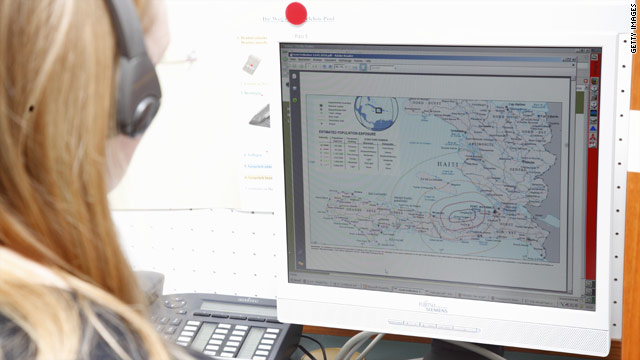
A worker at a crisis reaction center in Berlin, Germany, on Thursday views a map of Haiti


Call it Techies for Haiti.

On Saturday, groups of programmers, Web developers and other assorted technophiles will meet in Washington and other cities to brainstorm ways computer technology can help in the aftermath of the Haiti earthquake.

CrisisCamp Haiti will bring together professionals from tech companies, universities and government agencies for a free-form session of firing out ideas, then turning those ideas into action.

The result, they hope, will be tools that will help rescue workers find victims and help family members find loved ones, along with other kinds of computer-based assistance.

"It's a way to provide technological tools and expertise to help those who are on the ground in Haiti with their humanitarian relief efforts," said Gabriela Schneider, whose group, the Sunlight Foundation, will be hosting the Washington meeting. "It's kind of like the way Doctors Without Borders might go and help, or people from afar might get together to send goods."

The eight-hour event is being coordinated by Crisis Commons, a group which, according to its wiki page, "is meant to capture knowledge, information, best practices, and tools that support crisis preparedness, prevention, response, and rebuilding."

A similar get-together was scheduled Saturday for Silicon Valley, California, and organizers were trying to plan others in New York, Los Angeles, California, London, England, and Denver, Colorado.

As of Friday afternoon, nearly 100 volunteers had publicly registered to attend the Washington event. Their employers ranged from Internet startups to universities to government agencies, including the State Department and U.S. Geological Survey.

"It's a growing community that should not be underestimated," Schneider said. "They're tech-savvy and they know how to use networks well."

For Jonathan Nelson, a programmer and product manager who lives in Atlanta, Georgia, but telecommutes for a company in Washington, CrisisCamp Haiti is a chance to take some small action in a situation that otherwise felt overwhelming.

"You watch the news and it's like post-9/11 trauma again," he said. "Haiti is so far away -- you've got obligations here, but you want to contribute. I just thought, 'I've got to get up there.' "

Among the possible projects that participants plan to tackle:

• Building an open-source base layer map of Haiti that can be used by nongovernmental groups and others working in the country

• Creating an online locator system for families seeking lost loved ones

• Setting up an online communications tool similar to Twitter that would allow relief workers and others to talk with each other in real time

Other ideas could emerge. The group uses what's called the BarCamp model, which allows conversations and projects to develop organically and without hard and fast agendas.

"This is getting out of the red tape -- getting out of the corporate inefficiency -- and just having one common purpose and being very agile," Nelson said. "It'll all be a continual process."

Explosions, gunfire hit downtown Kabul

Kabul, Afghanistan -- At least two explosions and gunfire shook downtown Kabul on Monday morning, with the Taliban saying it was conducting a militant operation.

The attack started as 14 members of Afghan President Hamid Karzai's Cabinet were to be sworn in, said Parliament member Fawzia Koofi.

About 20 Taliban insurgents entered the presidential palace; the ministries of finance, mines and justice; and the Serena Hotel, said spokesman Zabiullah Mujahid. The militants claimed responsibility for one explosion, which was later followed by at least one another.

In a differing account, NATO-led forces said "several small explosions" and gunfire were reported near the Feroshgah e Afghan Shopping Center and the Serena Hotel.

At least two insurgents had been killed at the shopping center, NATO-led forces said in a news release, which also said that Afghan national police had secured all roads in the area.

An unknown number of downtown buildings were on fire, with smoke billowing above. It was not immediately clear which buildings were burning.

Monday's assault followed weekend violence that killed at least three international troops and 14 militants in Afghanistan, authorities said.

UN confirms death of Haiti mission chief Annabi

UNITED NATIONS – The UN mission chief in Haiti, Hedi Annabi of Tunisia, died in Tuesday's earthquake that devastated the country's capital, UN Secretary-General Ban Ki-moon announced Saturday.

He was believed to be 65.

In a statement, Ban also confirmed the death of Annabi's deputy, Brazilian Luiz Carlos da Costa, and of the acting UN police commissioner in Haiti, Doug Coates of Canada.

Ban gave no details of how the bodies of the three men had been found, but the world body said earlier this week they were under the rubble of the Hotel Christopher, the UN headquarters in Port-au-Prince, and could be alive or dead.

Haitian President Rene Preval said Wednesday that Annabi had died, but the United Nations said at the time it could not yet confirm that.

Annabi is the first UN mission chief to die in the line of duty since Sergio Vieira de Mello of Brazil was killed along with 14 other UN staff when a truck bomb exploded outside the UN headquarters in Baghdad in 2003.

Ban described Annabi as "the gold standard of service against which all who had the privilege to work with him were measured." He hailed the Tunisian's "unparalleled work ethic -- he was the first in and the last out every day for his entire career."

After working in the Tunisian foreign service, Annabi joined the United Nations in 1981. For nearly a decade he worked on a political settlement in Cambodia before joining the UN peacekeeping department where he rose to be an assistant secretary-general. He had held the Haiti job since 2007.

Ban said of Annabi, da Costa and Coates that "in every sense of the word, they gave their lives for peace."

By Friday, the UN death toll in Haiti had stood at 37. The deaths announced by Ban would raise that to at least 40, but U.N. official expect it ultimately to rise well over 100.

Powered by Blogger